What Employers in West Palm Beach Actually Want From a New Trade Hire
Every contractor in Palm Beach County will tell you the same thing. They can't find people. The phones ring, the jobs are there, the trucks are sitting in the yard, and they do not have enough hands to run them.
Then you look at the job listings and half of them say three to five years experience required.
So which is it? Are they desperate or are they picky?
Both. And understanding why is the first step to actually getting hired.
What Nobody Tells You About Getting In the Door
Contractors are not looking for someone who knows everything. They are looking for someone who shows up on time, works hard, does not create problems on the job site, and can learn. That sounds simple because it is. The bar to get your first helper or apprentice role is not as high as the listings make it look.
What actually gets you passed over is not lack of experience. It is showing up without basic safety habits, not knowing how to use tools without being a hazard, or not being able to have a professional conversation with a homeowner. Those things matter more than years on a resume, especially at the entry level.
Here is what employers are actually screening for when they interview someone new.
Safety first, always. Contractors cannot afford an injury. Workers comp, liability, OSHA exposure, a crew that gets rattled when someone gets hurt. If you walk in without any understanding of jobsite safety, PPE, lockout/tagout basics, or hazard awareness, you are a risk before you ever pick up a tool. Safety training is not optional. It is the first thing you need.
Basic tool competency. You do not need to be an expert. You need to know what a tool is, how to use it without hurting yourself or breaking it, and how to maintain your work area. Contractors will teach you the trade. They should not have to teach you how to hold a drill.
Reliability. Valid driver's license, drug free, shows up when scheduled, communicates when something comes up. This sounds like the bare minimum and it is. You would be stunned how many people wash out on this alone.
Troubleshooting mindset. This one takes time to develop but the instinct for it shows early. Do you follow a logical process or do you start replacing parts and hoping? Employers can spot the difference fast.
Customer communication. In residential service work especially, you are in someone's home. How you carry yourself, how you explain what you found, how you leave the work area when you are done. That stuff matters to the contractor's reputation and they know it.
HVAC
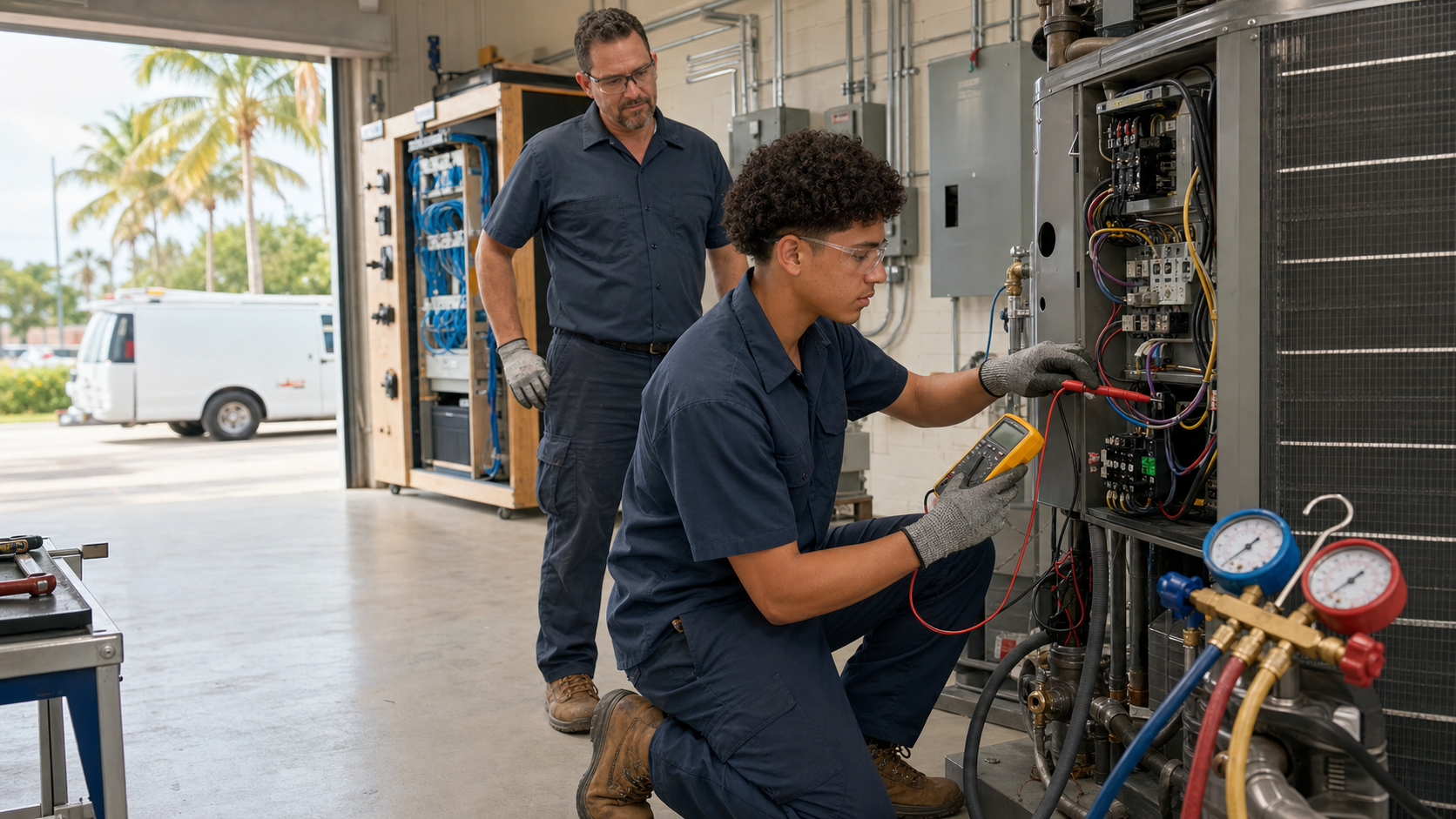
For HVAC the non-negotiable credential is EPA Section 608 certification. If you are going to handle regulated refrigerants, which in most HVAC roles you will, you need it. Full stop. Get it before you start applying.
Beyond that, employers want someone who understands how a system actually works. Not just the names of the parts but the refrigerant cycle, why pressures matter, how airflow and heat transfer connect. They want someone who can pick up a multimeter and use it safely on a capacitor or contactor without flinching. They want someone who can do a proper equipment start-up and document it correctly.
The customer piece is especially important in HVAC service because you are usually alone in someone's home diagnosing a problem and then explaining what you found and what it costs to fix it. If you cannot communicate that clearly and honestly you are not going to last long in residential service no matter how good your technical skills are.
Florida HVAC technicians with a few years of experience and good credentials are earning in the $50,000 to $70,000 range. The path there is real and it is not as long as people think.
Electrical
Electrical has a reputation for being hard to get into and there is some truth to that. The licensing structure is more formal, the apprenticeship programs are more structured, and the code knowledge required at the journeyman level is serious. But at the helper level the bar is much more accessible.
What electrical employers want from a new hire is basic theory, a working knowledge of safety, and the ability to run conduit, pull wire, and follow a set of drawings without constant supervision once they have shown you how. Blueprint reading is a skill that pays dividends fast. If you can look at a panel schedule and a floor plan and understand what you are looking at, you stand out immediately.
Electricians in this market are earning $48,000 to $80,000 with progression through apprenticeship and licensing. The ceiling is high and the demand is real.
Low Voltage
Low voltage is the most overlooked of the three trades and honestly one of the best opportunities in Palm Beach County right now. Security systems, structured cabling, access control, cameras, smart home, AV, fire alarm. The demand is coming from residential construction, hospitality, healthcare, schools, and commercial office space all at once.
What makes a good low voltage candidate is someone who can terminate and test cable cleanly, read a floor plan, use a laptop to configure a system, and communicate professionally with a homeowner or facilities manager. The technical skills are learnable fast. The professionalism piece is what separates the people who build a career from the ones who stay in the helper role indefinitely.
This is also a trade where the technology moves fast. Manufacturers update platforms constantly. The technicians who stay curious, keep learning new systems, and can troubleshoot a network issue as well as a hardware issue are going to be in high demand for a long time.
The Pay Reality
Entry level in all three trades is typically in the mid-twenties per hour right now in this market. That is the starting point, not the ceiling.
Here is what a lot of people outside the trades do not fully grasp. If you have the drive to eventually run your own business, the trades will get you there faster than almost anything else you could start. Service businesses are recession resistant. People still need their AC fixed when the economy turns. They still need outlets that work and cameras that record. The demand does not go away.
And even if owning a business is not your goal, there is something the trades give you that most white collar work never does. At the end of the day you can see what you did. You can look at a panel you wired, a system you commissioned, a room you cabled, and know that you built that. I spent years in corporate environments moving information from one spreadsheet to a PowerPoint that got presented for five minutes and forgotten. That is not a knock on that work. It is just a different kind of satisfaction than what you get when you can point at something physical and say I did that today.
The pay will keep going up because supply and demand are real. There are not enough skilled tradespeople to meet the demand that exists right now. Basic economics says that gap closes with higher wages. That is already happening and it is not slowing down.
Hands-On Beats Online Every Time
There are a lot of online trade programs out there. Most of them came out of COVID. Be careful.
Online has its place in trade training. Theory, code vocabulary, exam prep, understanding concepts before you touch the equipment. We use an online component in our own program for exactly that. But online alone is not trade training. It is training to pass a test, which is not the same thing.
The real learning happens when you are standing in front of a live system, something is not working the way the textbook said it would, and you have to figure out why. That troubleshooting judgment does not come from clicking through modules. It comes from doing it, getting it wrong, and doing it again with someone next to you who knows what they are looking at.
Muscle memory is not something you build on a screen. You build it with your hands on actual equipment, actual wire, actual tools. The students I have seen come through hands-on programs carry themselves differently than students who went online only. You can tell within ten minutes of watching them work.
If you are evaluating a program, ask one question before anything else. How many hours will I spend in a lab or on actual equipment? If the answer is vague, keep looking.
So Where Do You Actually Start
If a 22-year-old walked into my shop today and said they wanted to get into the trades, here is what I would tell them.
You have three real paths. If you have a family member who is a master electrician, plumber, welder, or HVAC tech and they are willing to take you under their wing, do that. You will learn faster than almost any other way and you will have someone invested in your success.
If that is not your situation, look at apprenticeship programs. An employer pays you to work as a laborer while sponsoring your technical training at night. You earn while you learn. The tradeoff is time. Apprenticeships take years.
If you want to move fast and you have the means to invest in yourself, do a hands-on trade program. Get your foundation, get your credentials, and get into the field. The students who come through a solid program and then land a helper or apprentice role are not starting from zero. They are starting ahead.
What I would not do is wait. The demand is there right now. The jobs are there right now. Every month you spend deciding is a month someone else is already in the field building experience.
Pick a lane. Get started. The rest follows.
We Built the Future. Then We Unplugged It…
This story is about 20 years old and it still bothers me.
Not because we did something wrong. Because we did almost everything right — and it still didn't work. That's the kind of lesson that sticks with you.
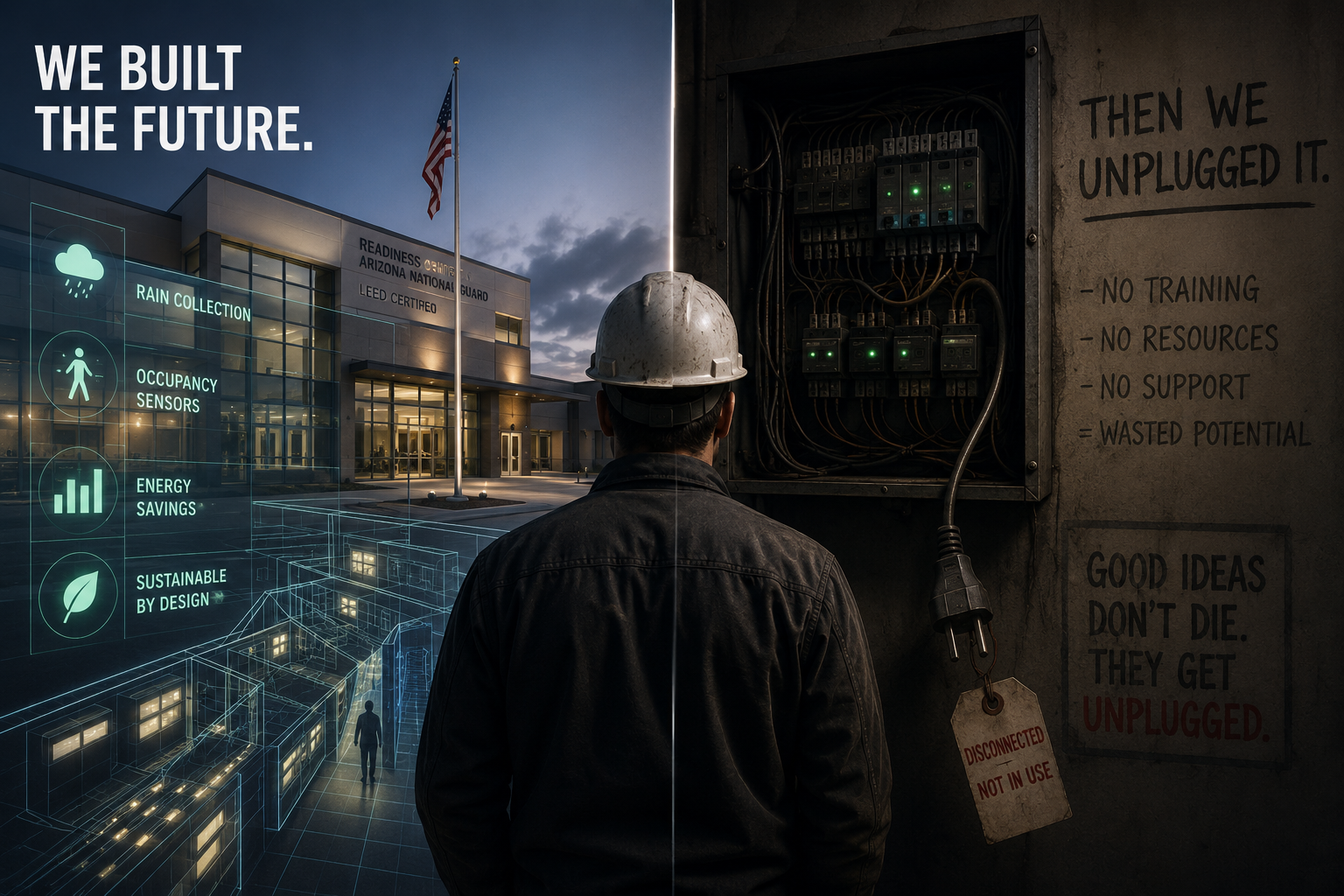
It was somewhere around 2007 or 2008. I was closing out one of my early LEED-certified buildings, a readiness center for the Arizona National Guard. For those who don't know, a readiness center is where Reservists and Guard soldiers come one weekend a month to train, store their gear, and do their jobs. It was one of the first LEED-certified readiness centers in Arizona. Maybe the first.
And it was loaded!
Rain collection systems. Occupancy sensors throughout the building. A full building management system. Lighting control zones that would activate as you walked down the hallway, bank by bank, lights coming on ahead of you and switching off behind you. The kind of thing that felt genuinely futuristic in 2007. The locker rooms were the same way. Troops could store their gear and the lights would respond to their movement automatically, never burning juice when nobody needed them.
The idea was simple and right: automate the conservation so the occupants don't have to think about it. People walking into a building aren't thinking about energy. They're thinking about getting their work done and going home. So you take the decision out of their hands entirely. The building does it for them.
I believed in it completely. I still believe in the idea of it.
About three days before we were supposed to hand the building over, I noticed a contractor at one of the control panels. Didn't think much of it the first day. The second day, I figured he was wrapping something up. On the third day I finally stopped and asked him what was going on.
He explained he was programming the lighting control system. Zoning it out, configuring the sequences, making sure everything responded the way it was designed to. I asked if it was going to delay our opening. He said no, this just takes time. Advanced system.
I walked back to the trailer and sat with that for a minute. This guy does this every single day. It's his whole job. And it took him three days to set it up.
Walter and Lonnie, led our facilities guys, the ones who were going to be responsible for maintaining this building from the day we handed it over, they were regular tradesmen. Good at their jobs. Comfortable with tools, HVAC systems, basic electrical, the everyday work of keeping a building running. This was 2007. None of them had ever touched a building automation system in their lives.
I called Walter and got him out to the site before the contractor left so his crew could get some exposure to the system. They showed up, looked at the panel, looked at each other, and looked back at the panel. They were lost. Not because they weren't capable, because nothing in their training or experience had prepared them for what they were looking at.
The contractor left. We opened the building. Soldiers showed up for drill.
A few months later I checked in with Walter on how the building was performing. He told me it was fine. Good, even. But then he said something I've never forgotten.
"Mike, we're not equipped, from a staffing and training standpoint, to handle all the electronics in these buildings you're building."
He was right. And I knew he was right the moment he said it. We had the budget to build the technology. We didn't have the budget or the time to train the people who were going to maintain it. That gap, the space between installation and operation, is where good ideas go to die.
They unplugged the whole system. Every piece of automation in that building, disconnected. That beautiful, expensive, carefully designed lighting control system that was going to save energy and reduce costs for the next 30 years sat dark in a panel room because nobody knew how to keep it running.
As far as I know, it's still unplugged today.
I've told this story more times than I can count throughout my sustainability career. And every time I tell it, the lesson lands a little differently depending on who's in the room.
For project managers: get your stakeholders in the room early and keep them there. I had included maintenance in the design charrette. They knew what was coming. But life gets busy, people get pulled away, and by the time the building was ready to open they were as lost as anyone. Checking a box at the beginning of a project is not the same as bringing people along for the whole journey.
For the industry: we need to stop measuring success at the ribbon cutting. A building isn't a success when it opens. It's a success ten years later when it's still running the way it was designed to run. That requires a plan for the people who maintain it, not just the people who build it.
For the tradesmen coming up right now: this story is more relevant today than it was in 2007. Buildings are smarter than ever. HVAC systems have software. Electrical systems have control logic. The line between mechanical and digital is gone, they're the same system now. The tradesman who only knows the physical side of the installation is going to end up standing in front of a panel with the same look Walter's crew had in that locker room.
The technology is not going to slow down and wait for the trades to catch up. That means the trades have to move toward it.
I genuinely believe today's tradesmen have an incredible opportunity in front of them. The demand is there. The pay is there. The stability is there. But there's a version of the future where we build a generation of smart buildings maintained by people who don't know how to run them, and we watch billions of dollars in technology get quietly unplugged because the gap between installation and operation never gets closed.
We always seem to find money to build something new. We rarely find money to teach people how to maintain it.
Don't let that be your story. Learn the system. Not just how to install it, how it thinks, how it fails, and how to bring it back when it does.
The future of the trades isn't just physical. It never was.

I spent $180,000 on two degrees I don’t use. Here’s what I learned.
I was supposed to be a music teacher.
Full scholarship. 1994. Eighteen years old, my parents just moved out of the country, and me, left alone with more freedom than I had any business having. I blew the scholarship inside of a year. Not proud of it. Just true.
Fast forward thirty years and I'm opening a trade school. Which means I guess I became a teacher after all — just a shop teacher instead of a music teacher. God has a sense of humor.
But that's the end of the story. Let me back up.
It Started With Cold Hands and a Skid Steer
In 1997 I was working at a restaurant in Kansas City with my girlfriend — now my wife, praise God for that — and one of our regulars pulled me aside and said he had a friend looking for a landscape foreman.
I told him I didn't know anything about landscaping and I was definitely not a foreman.
He said call him anyway.
I called. Got the job. Starting two or three levels above entry because the owner looked at my Army Reserve background and figured I could lead a crew. I was 22. I had never managed anyone in my life.
What followed were six years of wet boots, frozen fingers, and learning to love the feeling of ending a day having actually built something you could see.
I remember one winter in Kansas City, setting retaining wall boulders with a skid steer I barely knew how to operate. Middle of the season. The whole crew — every one of them Mexican, me the only gringo — were out there unzipping their sweatshirts like it was a mild afternoon. I was inside the machine and still couldn't feel my hands. I remember thinking these guys are something else. And I remember watching those boulders drop into place and thinking — yeah, I could do this for a while.
I did it until 2003.
The Army Taught Me One Thing That Matters More Than Anything Else
I joined the military my junior year of high school. My parents had to sign me up because I was old enough. I still don't fully understand why they said yes, I was probably being a knucklehead.
I went in as a combat engineer. Bounced in and out over the years — reserves, active duty, Iraq. Not all of it was good. Had a stretch in Hawaii with a bad unit and I had a bad headspace. But the rest of it? I'd do it again.
What the Army gave me wasn't a skill set. It was a standard.
When you're on a team where nobody cares what car you drive or where you grew up — where the only thing that matters is whether you do your job and cover the guy next to you — it rewires how you think about work. The mission mattered. Everything else was noise.
I carry that into every room I walk into. Still do.
I Bet My Job on a LEED Building Nobody Thought Would Work
By 2006 I was a project manager for the State of Arizona, building facilities for the National Guard. Congress hands you a funding document, tells you how many millions you have, and you go build a building. Straightforward enough.
Except I had this idea.
Sustainable construction was barely a conversation in the military at the time. Expensive. Unvetted. And honestly, I didn't care that much about saving the planet and honestly, I wanted to stand out from the other project managers so I could get promoted.
My Colonel said no. I kept pushing. Finally he looked at me and said: "Fine. But you can't go over budget and you can't miss schedule. You fail — you resign."
I shook his hand.
We built the first LEED-certified building in the entire United States Army. Went on to build three more. Then designed and built the country's first sustainability training ground — a whole complex of facilities in Florence, Arizona, built to green standards from the ground up.
The regulation requiring it didn't come down from Big Army until 2010. We beat it by four years.
Getting the right people in the right seats. That's what made it work. Great architect. Great engineers. A contractor that became one of my closest friends and I miss him still, we lost him a few years ago 🙁. You can have the best idea in the room and still fail if you build with the wrong people.
GOEFER: Everything That Can Go Wrong, Will
After a consulting gig fell apart, I woke up in the middle of the night with a vision to build a smart power strip that tracked and controlled energy at the device level.
I didn't know software. I didn't know hardware. I didn't know supply chains, marketing, cap tables, pitch decks, or how to convince someone to write me a check. All I knew was how to build a building.
I thought, how hard can it be? It's a power strip.
Turns out — extremely hard.
I found a partner. He was supposed to handle the software. A couple of years in, three months from a final launch, he quit. That was the moment I understood what a wrong partner actually costs you. Not just money — time, trust, momentum, and a chunk of your time and effort you don't get back.
We shut GOEFER down in the fall of 2019. Sold everything off. COVID hit three months later and wiped out the entire commercial plug-load market we were chasing. God closed that door before the building burned down.
My wife — who had watched me grind through three hard, hard years in our life and marriage — told me after we closed it and I was feeling such failure and felt I would never find another job, that I had learned more about business in those three years than most people learn in a career. She was right. My career took off after that. Went on to run global sustainability programs, built a team of 250 people across 30 countries, sat at tables with boards and investors and Fortune 100 executives.
GOEFER taught me all of it.
Teaching Executives What Nobody Taught Them
ASU called me about four months after I finished my undergrad and asked if I wanted to be one of the first twelve students in their new Executive Master's in Sustainability Leadership. Only program of its kind in the world at the time.
I said yes. Of course I said yes. I say yes to most things I don't know how to do.
They called again after I graduated and asked if I'd help build the online version and teach it. I told them I didn't know how to build courses or teach. They said try it anyway.
I taught for four or five years. Built the intro courses and the capstone program. Had executives from Harley-Davidson, Verizon, Johnson & Johnson. Had startups, nonprofits, government agencies. Had a mom who launched a dog poop pickup program in her neighborhood and treated it like a Fortune 500 initiative.
What I learned from doing that is that most people are more capable than they think — they just need someone to treat their idea like it matters and push them to do the actual work. Looking back I see one of my gifts is my ability to encourage people to tackle what they think is impossible.
I made every student pick a real project at their real job. No theoretical homework. You're going to do this at work, get double credit, and stop pretending school and life are separate things.
Looking back now, I've been teaching my whole life. My landscaping crews. My military teams. My Bible study guys. My Cub Scouts. My sustainability councils. I just never called it teaching. I called it leading.
How a Lunch at Mission BBQ Changed Everything
November 2024. I got laid off on my 49th birthday.
Great job. Great team. Gone. Because sustainability became a political football and the market dried up on an election cycle. A career I'd spent 20 years building, evaporated.
I was running a men's Bible study at the time and had lunches lined up with the guys that week. Second lunch, sitting across from my friend at Mission Barbecue, still raw from the layoff. He had been a successful pilot. Got the COVID vaccine and it wrecked him. Disability in his 50s. Looked around for something new, found an HVAC program locally, went through it, worked in the field a little, realized he was too old to be crawling through attics, and started teaching there instead.
He looked at me and said "I think you should open a trade school."
I told him he was out of his mind.
We spent the next week talking through what it could look like. I kept looking for jobs (actually I kept looking for jobs up until Christmas of 2025. I had walked out of an interview for a seasonal role at Costco and while in the parking lot my phone beeped telling me we had sold 3 shop classes (a story for another day)). Kept getting nowhere. The Holy Spirit kept poking at me. I kept pushing back.
By February I knew I wasn't going to stop thinking about it. But I also knew I wasn't doing it without my wife. GOEFER had nearly wrecked us. I wasn't putting her through that again without her being fully in it.
We prayed about it. We talked about it, me a lot more than her haha. We took a second mortgage on the house for seed money. She got cold feet. I shut everything down. She said don't stop. I just need to process it more. And then somewhere around March of 2025 she said let's do it — and she's been all in ever since.
Why I Actually Did It
The existing trade school model is broken. Not the people running them — the model itself.
You wait four or five months to start. You sit in classrooms longer than necessary. You pay $10,000 to $15,000 for a credential you could have earned in twelve weeks for a fraction of that. And nobody treats the student like a customer whose time actually matters.
Today's generation doesn't wait. They shouldn't have to.
I spent $60,000 of the Army's money and $120,000 of my own on two degrees I don't use. I'm glad I did it. I wouldn't do it again. And I refuse to build something that asks the next generation to make the same mistake when there's a better path sitting right in front of them.
I'm not anti-college. I'm anti-wasted-potential. There's a difference.
The trades are real. They're not going anywhere. People don't need Facebook. They need a working toilet. They need someone who can fix their AC in a Florida summer or change the oil in their cars. They need roads and buildings and the people skilled enough to build and maintain them.
Technology will change the trades. It won't replace them. Not ever.
I've been on job sites and in boardrooms. I've managed million-dollar construction projects and sat in front of boards of directors. I've taught executives and mentored veterans and coached guys who didn't think they were capable of anything.
I've been a teacher my whole life. I just finally got a classroom.
There is no AI without a Tradesmen
Everyone's arguing about whether AI is going to take their job.
Meanwhile, somebody's got to wire the building it runs in.
Let me explain what I mean, because I think we're having the wrong conversation.
The Cloud Isn't a Cloud
When people say "the cloud" they picture something invisible. Weightless. Floating somewhere above us, humming quietly, not bothering anyone.
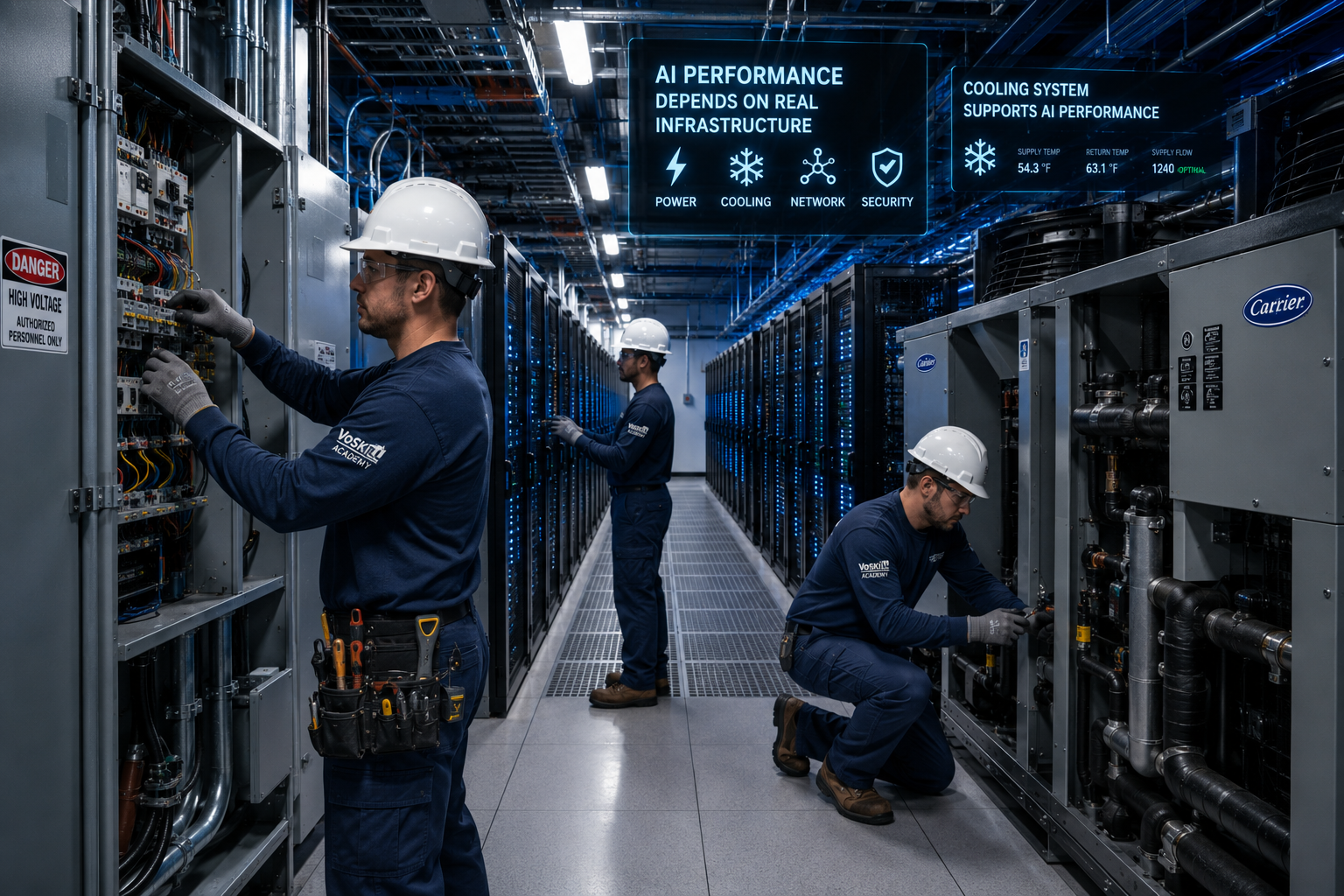
The reality is acres and acres of hardware. Rows of servers stacked floor to ceiling, running hot, drawing massive amounts of power, cooled by complex HVAC systems — both closed loop and open loop — sitting on floating floors so technicians can get underneath to the networking infrastructure. Physical security to keep nefarious players from walking in and pulling critical data off a server. Redundant power systems because if one thing fails, nothing goes down. Drivers dump. Hardware fails. Somebody's got to go in there and pull the dead unit and replace it.
Data centers could be one of the most infrastructure-heavy environments ever built. And we're building more of them every month because AI runs on electricity and electricity runs on infrastructure and infrastructure is built and maintained by tradesmen.
There is no AI without the electrician who wired the data center. There is no AI without the HVAC tech keeping those servers from cooking themselves. There is no AI without the network tech, the diesel mechanic keeping the backup generators running, the guy who laid the conduit, pulled the wire, and terminated the connections.
The ones and zeros have to sit on something. That something is hardware. And hardware doesn't build or maintain itself.
So before we get into a panic about AI coming for jobs, let's put that in context.
What AI Is Actually Going To Do To The Trades
It's not going to replace tradesmen. Not in my lifetime, and probably not in yours.
Have they built a robot that puts a roof on? Sort of. Could they build one that changes a tire or pulls wire through conduit? Probably. But we've had solar since the 1970s and it's still not mainstream because the economics don't work at scale. AI-powered trade robots are the same story. Cool technology. Wildly expensive. And people won't pay it until the price drops far enough — which means human labor wins until then.
What AI is going to do is gut a lot of white-collar work. The first one or two years out of a four-year degree — the intern work, the PowerPoint work, the document scrubbing, the first-draft writing — that's already going away. I spent hundreds of hours of my career making PowerPoints for meetings. AI knocks that out in ten minutes. That's not coming back.
For the trades, the disruption is different and honestly it's mostly good news. AI is going to handle the back end that tradesmen are historically terrible at. And I say that with love, because I've worked alongside enough of them to know it's true.
You can't get a plumber on the phone because he's buried. Not because he doesn't want your business — because he has no system. No one answering calls. No automated scheduling. No invoice that goes out the same day as the job. He's running on memory and a paper receipt book and sheer force of will. AI can fix all of that. And when it does, the tradesman who adopts it early is going to run circles around the one who doesn't.
I Watched It Happen on a Rooftop
We were up on a roof working on a rooftop unit that was just whooping us. The software side of these modern commercial HVAC systems is no joke — and the market doesn't have nearly enough people who understand both the mechanical and the digital side of the same machine. That's a whole other article.
But I watched the guys pull out their phones and start working through the problem with ChatGPT. Describing the symptoms. Uploading pictures of the hardware. Asking it to help them interpret the control logic.
It wasn't perfect. AI is never perfect, and anybody who tells you otherwise is selling something. But it moved them forward faster than going down a dozen rabbit holes on their own. It's Google on steroids — and for a tradesman trying to troubleshoot an unfamiliar system on a hot roof on a Tuesday afternoon, that matters.
Here's what I'd want every tradesman to do this week, not someday — this week: open ChatGPT or Claude, take a picture of whatever you're working on, describe the problem, and just let it think. Then push back on it. Teach it what it's missing. You'll be surprised how fast it adapts, and you'll also find the gaps pretty quickly. It doesn't walk on water. But used right, it's a serious tool.
What the AI Toolbox for Tradesmen Actually Looks Like
If I had a magic wand I'd build something like this.
Before every job, the system gives the tradesman a briefing. Here's the address, here's the scope, here's what tools you're going to need, here's what materials you might be short on based on what was ordered. Everything they need to know before they walk through the door — laid out clean, on their phone, in plain language.
While they're working, a small AI recorder on their shirt is listening. Capturing what they're doing, what they're seeing, what's working and what isn't — in their own voice. That audio becomes a database. That database becomes the next generation of training content. Imagine sitting next to an experienced tradesman for sixty hours a week and capturing everything he knows. That's an asset nobody has thought to build yet.
When they pull away from the job, a prompt pops up on their phone: anything to add to the invoice? Three taps and it's sent. Payment collected. Job closed. Done before they hit the end of the street.
That's not fantasy. Every piece of that exists today. It just hasn't been assembled into a tool built specifically for the trades. Whoever builds that company is going to do very well.
What This Means for Training
I'll be honest — when I got this question I hadn't fully thought through how AI fits into what we're teaching at VoSKILL Academy. But I'm thinking about it now, and here's where I land.
The core curriculum stays tactical. Here are the systems. Here's how they work. Here's how to install, maintain, and troubleshoot them. That doesn't change because AI exists.
But I want to add one thing: teach them AI as a tool. Demystify it. Show them what it can do, show them where it falls short, and send them into the field understanding that it's one more resource in the toolbox — not a threat, not a magic answer, just a tool. Same as a multimeter. Same as a manifold gauge set. You learn what it does, you learn its limits, and you use it when it helps.
The tradesmen who figure that out early are going to work smarter than everyone else on the job site. And the ones who own their own businesses and figure out how to automate the back end with AI? They're going to build something real.
The ditch diggers were afraid of the Ditchwitch. The guys selling horses were afraid of the steam engine. Every generation has this moment where a new tool shows up and half the room panics and the other half gets to work figuring out how to use it.
Be the second group.
The trades built the world AI runs on. Might as well learn to run AI too.